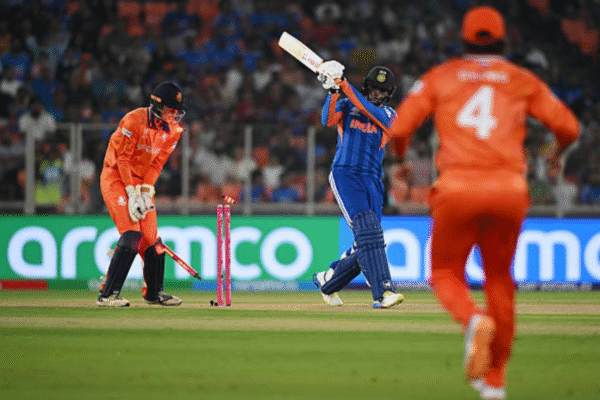


India won all their group stage games in T20 World Cup 2026.
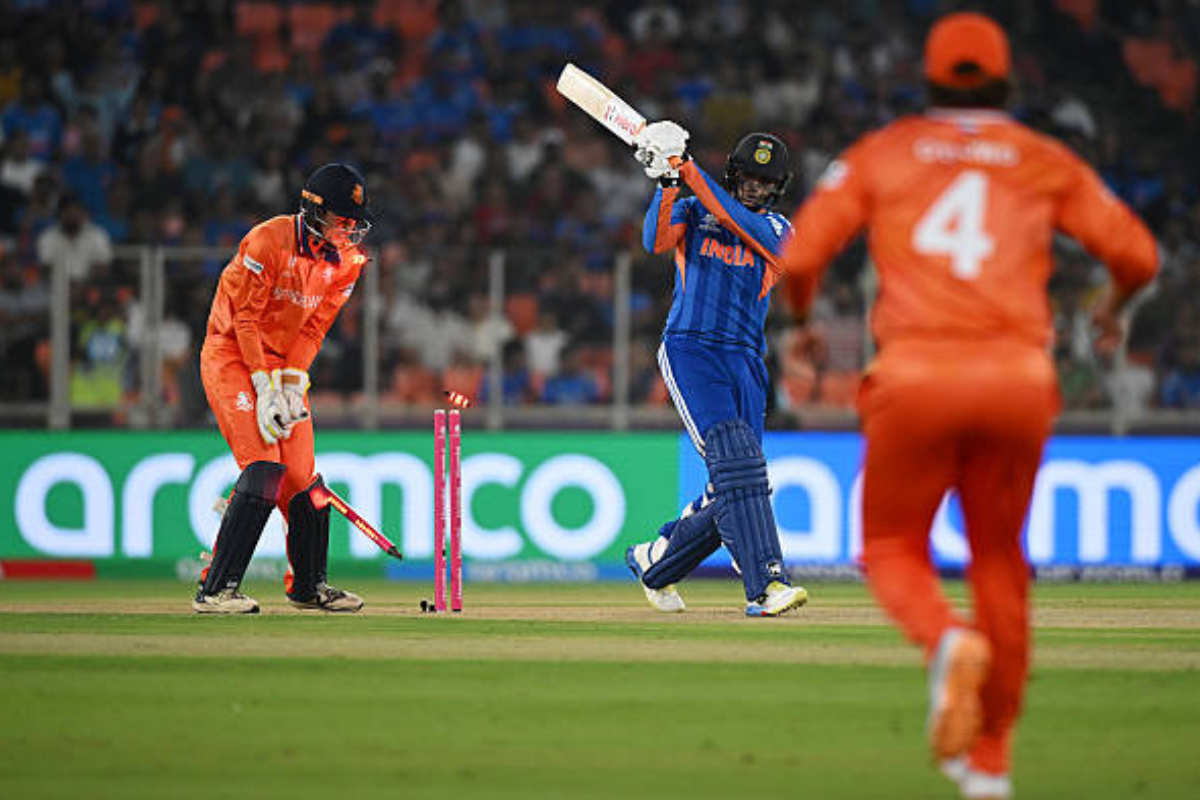
Though the defending champions, India, have dominated the group stage in Group A, winning all four games, there is one area where they have struggled largely during the T20 World Cup 2026. Their batting lineup was considered the most feared among all other teams, but they haven’t been able to replicate what they did in all the bilateral series they played since the T20 World Cup 2024. This led us to analyse their performances and find an answer to the question: Why have Indian batters not been able to fire at their full potential?
The main reason behind this has been that the opposition teams at the T20 World Cup 2026 have come up with a straightforward, data-supported strategy against India — bowl off-spin and bowl a lot of it. The outcomes so far suggest this hasn’t just happened by chance, but it’s because of tactical match-ups, varying conditions, and some unexpected dips in individual performance.
The structure of their batting line-up is most evident. Their top eight has six left-hand batters, which makes them easy targets for off-spinners. It’s no surprise that opponents have focused heavily on this match-up, as it is considered that bowlers who take the ball away from the batter are difficult to hit compared to those who bowl into the arc.
During the group stage, the Men in Blue have faced more off-spin than any other team, totalling 102 balls. Of the 13 teams that faced at least six overs of off-spin, India’s scoring rate of 6.23 per over ranks as the third lowest, only ahead of Nepal (5.25) and Oman (5.42). Notably, both teams have been eliminated from the T20 World Cup 2026. Outside of Namibia (6.80), all other teams scored eight or more runs per over against off-spin, hinting at potential weakness exposed during the tournament.
Wickets have followed the low run rates. India’s average of 13.25 against off-spin highlights how consistently this bowling style has hurt them. It’s not just about the volume; the left-handers have struggled more against off-spin than left-hand batters from most other teams.
Conditions have worsened the problem. India have needed to adjust quickly between very different pitches—ranging from slow, turning surfaces in Colombo to quick, uneven tracks like those in Ahmedabad.
The Netherlands spinner Aryan Dutt exploited the conditions quite well, returning the figures of 4-0-19-2 while maintaining a pace of 98–99 kph. He didn’t offer any room to their batters and cramped them when they attempted to play it towards the leg side.
ALSO READ:
Individual performance has also played a role. Abhishek Sharma, arguably India’s most fearless batter against spin, has struggled with an unfortunate start to his World Cup career, scoring three ducks on the trot, with two dismissals while attacking off-spin, including one against an unexpected new-ball spell from Pakistan captain Salman Agha.
Before the T20 World Cup 2026, Abhishek scored 103 runs off 65 balls against right-arm off-spinners. He had an average of 25.8 and a strike rate of 158.5. In those 14 innings, he was out only four times and faced just 38.5% dot balls. In the T20 World Cup 2026, he has already been out twice in seven balls and has yet to score a run. With Abhishek out of form, India have been put under pressure in the first over itself.
In the No. 3 spot, Tilak Varma has faced 35 balls of off-spin in the T20 World Cup 2026, second only to Quinton de Kock (who faced 40 balls for 35 runs). Tilak has managed 31 runs off those balls and been out twice, and his strike rate has been just 88.6. Notably, before the T20 World Cup 2024, the southpaw has scored runs at a 139.4 strike rate against off-spinners and played only 35.4% dot balls, showcasing worrying signs.
Meanwhile, Suryakumar Yadav, who rescued India from an upset against the USA, has scored 28 off 27 against off-spin with one dismissal but has been slow early against pace, managing 29 off 26 balls in the first 10 overs, compared to Tilak’s 62 off 41. This contradicts the approach with which they played in the bilateral series post the T20 World Cup 2024 and the way they are batting in the ongoing tournament.
However, India know what to expect in the T20 World Cup 2026 Super 8. They will face tough challenges from undefeated teams like South Africa, West Indies, and Zimbabwe, who defeated Australia clinically, and are in the same group. While South Africa doesn’t have a specialist off-spinner, Aiden Markram might bowl his full quota of overs. They also have another spin option in Tristan Stubbs, though he hasn’t bowled much at the international level. West Indies and Zimbabwe will rely on Roston Chase and Sikandar Raza to put pressure on India’s batters, respectively.
India assistant coach Ten Doeschate noted that while finger spin is a clear threat, larger ground dimensions and slightly helpful pitches have also allowed spinners to dominate certain parts of the game.
“Teams are bowling a lot of finger spin at us because we have so many left-handers in our lineup. That is a challenge. We don’t have many options. We’ve got Sanju sitting on the side,” ten Doeschate said after the Netherlands game. “I’d say finger spin. These two venues, with their bigger boundaries and the slower wicket in Colombo, do make that more pronounced. With the amount of finger spin we will face in the next three games, we must manage that part of the game,” he added.
Whether off-spin continues to dictate play may depend on pitch conditions, small tactical adjustments, and whether Abhishek finally finds his rhythm. For now, the numbers are clear: off-spin has been the most effective weapon against India.
For more updates, follow CricXtasy on Facebook, Instagram, Twitter, and YouTube.