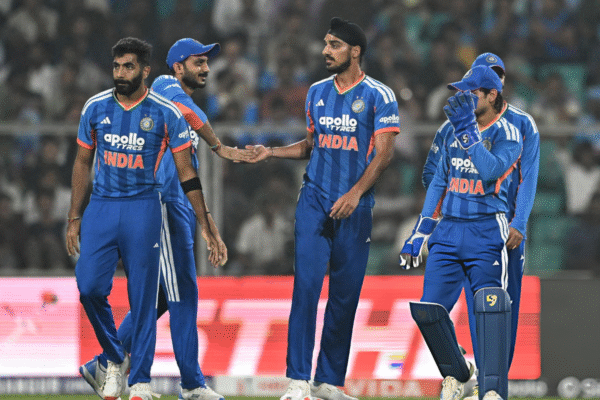


India start the T20 World Cup 2026 as favourites.
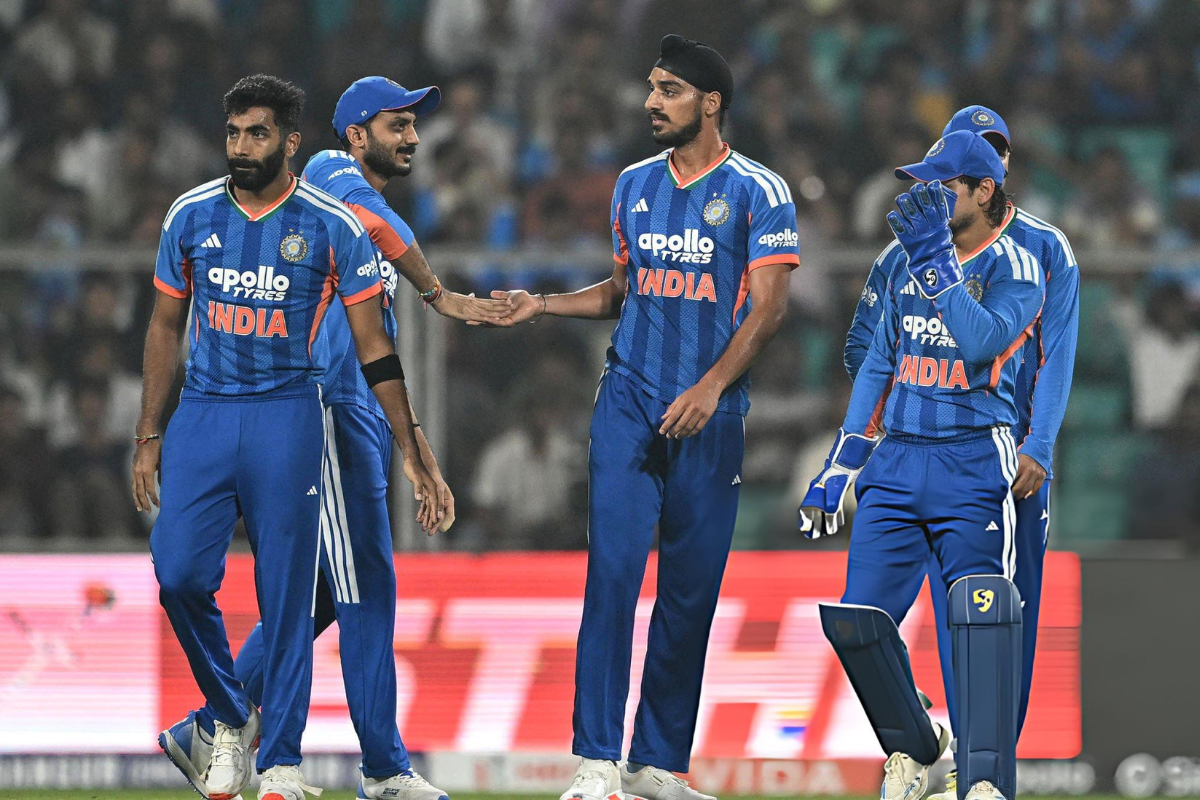
It is rare to see a team enter a tournament with the level of favouritism that surrounds India ahead of the T20 World Cup 2026. They top every T20I metric out there and bring a team full of match-winners at home. Invincibility rarely looks more convincing.
But this is still a T20 format, and World Cups bring a completely different dimension. No player or team can ever be perfect across every aspect. As strong as India are, the opponents can still pick a few areas to target and get themselves into the game with precise planning.
We nitpick the possible ways India can be defeated at the T20 World Cup 2026.
Abhishek Sharma will be the prize wicket at the T20 World Cup 2026, and teams might have a clue based on recent trends about how to stop him. He has shown a tendency to move towards the ball and make contact even before the ball reaches its full height after bounce, which has obviously helped him precisely access the cover region. However, pacers can still control him by bowling wider lines with an away angle in the powerplay since he steps away while coming down the track and will need to extend his reach.
The data shows that in the recent three series against Australia, South Africa and New Zealand, Abhishek had a strike rate of 120 and hit only four boundaries across 20 deliveries going away from him while coming down the track. 16 of those balls (80%) saw false shots, where he was trying to connect but either missed it completely or could only get edges. His false shots will anyway be unusually high, given the high-risk cricket he plays, but he clearly misses more than he hits on deliveries going away from him; he has been in control on 61.53% other deliveries.
Lines are again crucial on such balls because whenever they are on the off-stump or wide of it, his strike rate remains 100. Whenever lines become straighter, the strike rate surges to 144.44. Even in general, whenever Abhishek has stepped out of his crease and lines have been away from his arc, the strike rate remains 106.66, compared to 225.80 on all the middle and leg stump lines.
Before the Asia Cup 2025, we covered an elaborate piece on how Hardik Pandya has issues against shorter lengths into the body. Since his return, he has been magnificent as a batter, especially against spin, but his problems with pace remain, even if overall numbers have improved. He now starts quickly, but pacers can still restrict him by bowling straighter lines into the body.
Since the South Africa series, Hardik has a strike rate of 121.42 and has been dismissed twice in 14 balls against back-of-length or shorter deliveries on the middle, off-stump, or outside off-stump lines. Any width on either side of the stumps has seen a strike rate of 255.55. A prime example of how to restrict him came during the warm-up game against South Africa, where Corbin Bosch targeted him with non-fuller balls.
He bowled short balls outside the off-stump line and generated two chances inside three balls. Hardik was clearly uncomfortable with it and eventually lost his wicket. India will play two group-stage games in Mumbai and Ahmedabad, and another two in Ahmedabad in the Super Eight phase, where they likely qualify.
The bounce usually remains high on these surfaces, given India will likely prefer red-soil surfaces in Ahmedabad as well. That’s where Hardik’s issues against shorter length deliveries can come to the fore, and teams with express pacers can exploit it. The margin of error is low, especially in the form he’s in, but pacers still have something to work with.
Harshit Rana has been ruled out of the T20 World Cup 2026 due to a knee injury, with Mohammed Siraj named as his replacement. In Rana, India had more cushion in the batting department and a perfect bowler with the right attributes. He gave India the liberty to use him as an additional batter in the lower order and act as an enforcer in the middle overs.
His presence meant India could have used Jasprit Bumrah and Hardik Pandya in their suitable roles: Bumrah in the toughest overs like closing powerplay and death overs, while Pandya with the new ball in the powerplay. In Arshdeep Singh and Mohammed Siraj, India still retain high skills in the powerplay and slog overs, but they are not suited to hit the deck hard in the middle overs and complement spinners.
Hardik can do the role of an enforcer, but Harshit’s value would have been immense on the pitches India will play. Since 2025, Harshit has bowled around 17.85% of his T20I overs between set numbers 7 and 15. Only Hardik Pandya (27.54%) has bowled more, but he is not an enforcer and can be vulnerable on flat surfaces, even if his natural lengths are short.
Meanwhile, Arshdeep and Siraj hardly bowl in the middle phase. On the batting front, India will also be without Washington Sundar, at least in the initial phase of the tournament, so the depth will definitely take a hit. They still have a fairly long batting lineup, but more cushion would have helped them, and it’s something they have preferred under the new management.
MS Dhoni made an interesting point about how dew can take skills out of the equation at times, and it’s something India have been on the wrong end of before. Take the T20 World Cup 2016 semifinal or the World Cup 2023 final – India’s skills took a back seat due to the conditions. All of India’s matches will be played at night, and dew will be a massive factor.
ALSO READ:
If India bat first and score even something around 210, the total won’t be safe against strong batting lineups like Australia, South Africa or West Indies. Such matches are decided on individual brilliance, and any batter going berserk can win the game on his own. That fifth T20I against New Zealand serves as the best example, where India made 271 in the first innings, and the Kiwis came close with 225.
If any of the batters had played a relatively slow knock for India, they could have ended with somewhere around 220 or 230, and New Zealand would have chased it down. Even Jasprit Bumrah went for 14.50 runs per over. So, the toss will become a massive factor, and toss and dew are two things they can’t control from any point.
India, if they bat first, will be under immense pressure to post an above-par score. In big matches, the gap between the two teams can lessen, as Lendl Simmons’ innings in 2016 depicted. They practice bowling with wet balls and all that, but in-game pressure against the best batters brings a different dimension that can force mistakes even from the best.
For more updates, follow CricXtasy on Facebook, Instagram, Twitter, and YouTube.