

GT will need to swap roles in the powerplay.

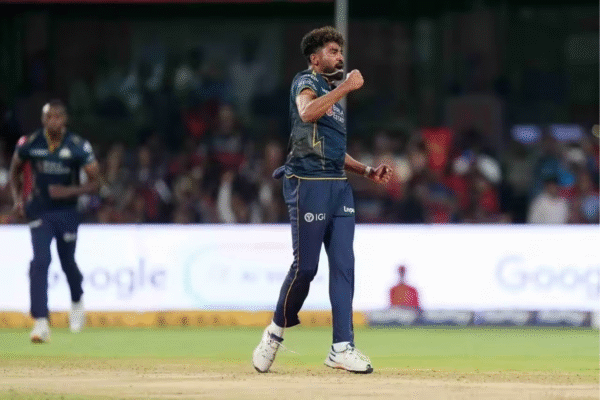
Gujarat Titans (GT) pacer Mohammed Siraj has been underperforming in the powerplay this season. He has been economical during the field restrictions with the ball, but wickets haven’t come as much as GT would have wanted. He has three wickets at 43 runs apiece and an economy rate of 7.17 in the powerplay in IPL 2026.
He hasn’t bowled too poorly, as his economy rate shows, but wickets haven’t come. This, despite bowling in Ahmedabad, where the new ball swung more than in any other venue. The solace for GT is that Kagiso Rabada has stepped up at the right time and done the heavy lifting with the new ball.
ALSO READ:
Jason Holder played his first game against Royal Challengers Bengaluru (RCB) and bowled the 6th, 12th, 14th, and 19th over. He did reasonably well and was among the more economical bowlers for GT. However, Holder should be used more with the new ball against CSK.
He has a tremendous record against both openers – Sanju Samson and Ruturaj Gaikwad – in T20s. Jason Holder has dismissed Sanju Samson four times in 60 balls in the format. The batter has averaged just 18.50 and struck at 123.33.
Meanwhile, Gaikwad has also lost his wicket twice in seven balls against the lanky pacer. It’s a small sample size, but the CSK captain surely has issues with Holder. So, GT can look to exploit it early on in Chennai, where pacers have had significant new-ball movement in the air.
Siraj has also done well against Samson, dismissing him three times in 35 deliveries. But his recent lack of wickets makes him slightly vulnerable against an in-form batter. Hence, Holder should bowl from one end, with Rabada operating from the other end.
He knows how to bowl and move the new ball; that’s been his strength at times, despite his recent evolution in other phases. Since 2025, Holder has 32 wickets at an average of 28.18 and an economy rate of 8.12 in the powerplay. As an opening bowler, he has 53 wickets at 20.69 runs apiece, conceding around 8.08 runs per over in this timeframe.
If GT front-load Jason Holder, they can use Mohammed Siraj with the old ball outside the powerplay, where he has decent attributes to succeed, despite recent struggles. He has had issues in death overs this IPL, but might work against CSK. They have a shaky middle and lower middle order, and even Shivam Dube hasn’t fired enough so far.
Collectively, CSK’s lower middle order (No.5 or below) have an average of 20.18 and struck at just 131.75, losing a wicket every 15.31 deliveries, in IPL 2026. So, if Siraj bowls with the old ball, he can bowl against inferior players, who have not performed at their best, with specific plans. For instance, Dewald Brevis can be stifled with short balls, as was visible in the last game, while Dube has also shown signs of regression on the back foot this season.
Meanwhile, Kartik Sharma has yet to find success, and while Jamie Overton has solid power, he has yet to gain consistency in the league. Siraj can also extract reverse swing at the back end of the innings. He has a higher pace than Holder and will be better equipped to generate old-ball movement in Chennai.
If Jason Holder bowls with the new ball and removes the openers early, Siraj’s job will become a lot easier. This will also help them cover for Ashok Sharma’s absence, as he had to sit out to accommodate Holder. It’s not that GT need to employ this tactic in every match, but against CSK, it’s a move worth taking.
For more updates, follow CricXtasy on Facebook, Instagram, Twitter, and YouTube.